The Fascist Playbook
Why Trump's own generals call him a fascist—and what the historical pattern reveals
The Label
In October 2024, General Mark Milley—Chairman of the Joint Chiefs of Staff under Trump—told journalist Bob Woodward that his former boss was "fascist to the core." Days later, Trump's former chief of staff John Kelly confirmed to the New York Times that Trump praised Hitler's generals, wanted generals "like Hitler had," and fit "the general definition of fascist."
These weren't partisan insults. They were assessments from the men who stood closest to power—a four-star Marine general and a four-star Army general who served as Trump's senior-most military advisors. They chose a word that most politicians avoid: fascist.
Milley's full quote was stark: "He is the most dangerous person ever. I had suspicions when I talked to you about his mental decline and so forth, but now I realize he's a total fascist. He is now the most dangerous person to this country."
This was not the first time Milley feared Trump's authoritarian impulses. In 2021, Milley had privately worried about a "Reichstag moment"—the 1933 fire that Hitler used to suspend civil liberties and consolidate power.
The scholar who provides our framework is Umberto Eco, the Italian novelist who grew up under Mussolini. In his 1995 essay "Ur-Fascism," Eco identified fourteen characteristics of "eternal fascism"—features that recur across different fascist movements. Not every movement exhibits all fourteen, but the presence of any one, Eco warned, allows fascism to "coagulate around it."
This essay examines Trump's movement against that framework—not as rhetorical exercise, but through documented conduct. The question is structural: Does Trump's movement function like historical fascism? Does he cultivate the violent, the racist, the paramilitary? Does he reward them?
The evidence suggests yes.
The Framework: Five of Eco's Fourteen Features
Eco's essay identifies fourteen characteristics of "eternal fascism." This analysis focuses on five that are particularly observable in documented conduct:
1. The Cult of Tradition and Heroic Restoration: A mythologized past that must be recovered. The nation has been humiliated; only a heroic leader can restore it.
2. Fear of Difference and the Out-Group: Enemies are constructed as existential threats—immigrants, minorities, the press, political opponents—who contaminate the nation.
3. Appeal to a Frustrated Middle Class: Followers are told their rightful status has been stolen by elites and outsiders. Only the leader speaks for "real" Americans.
4. Machismo, Contempt for Weakness, and Cult of Action: Violence is glorified; masculine strength is praised; thinking is suspect.
5. Selective Populism and Contempt for Parliament: The leader claims to embody the will of "the people," rendering institutions—courts, legislatures, press—illegitimate obstacles.
The sections that follow trace how Trump's documented conduct maps to these features.
The In-Group
Every fascist movement begins with a mythologized national identity—a "true" nation that has been betrayed, humiliated, and must be restored to greatness.
Trump's campaign announcement on June 16, 2015 established both elements in a single speech. The country had been made weak by corrupt elites. Outsiders were invading. Only he could fix it. "When Mexico sends its people, they're not sending their best... They're bringing drugs. They're bringing crime. They're rapists."
By his 2016 RNC acceptance speech, the mythology was fully formed. He declared "I alone can fix it"—one of the most explicit cult-of-personality statements in modern American political history.
"I alone can fix it." — Donald Trump, Republican National Convention, July 21, 2016
This is what Eco called the "cult of the hero"—the leader who embodies the nation, who requires no advisors or institutions because his will is the national will. The hero is masculine, decisive, unconstrained by procedure. His followers don't just support him; they identify with him.
At rallies, Trump described his supporters with language of masculine strength and implicit violence. At a Johnson City, Tennessee rally in 2018, he claimed "strong, tough" supporters approached him "with tears in their eyes" to thank him for "saving our country."
By his second term, the in-group construction became explicitly biological. At a New Hampshire rally, Trump told supporters that immigrants are "poisoning the blood of our country."
"Poisoning the blood" comes from Hitler's Mein Kampf, where it described racial contamination. When confronted about the parallel, Trump claimed he had never read Hitler. He then repeated the phrase at subsequent rallies—and, as Kelly confirmed, privately praised Hitler's generals.
The Out-Groups
If the in-group is defined by mythological purity, the out-groups are defined by contamination. Fascism requires enemies—not merely opponents to defeat in elections, but existential threats to be expelled or eliminated.
Immigrants as Invaders
Trump's dehumanization of immigrants followed a clear progression: criminals → rapists → animals → disease vectors.
In December 2015, he called for a "total and complete shutdown" of Muslims entering the United States. Before that, he floated closing mosques and endorsed a Muslim registry database. When a reporter asked Trump how a Muslim database differed from Nazi registration of Jews, he responded four times: "You tell me."
Once in office, Trump signed the "Muslim Ban" executive order. When a judge blocked it, he attacked the "so-called judge"—asserting that judicial review itself was illegitimate.
At a 2018 White House roundtable, Trump called certain immigrants "animals": "These aren't people. These are animals." That same month, his Attorney General announced that zero-tolerance would separate families. The policy's architects described deterrence as the goal; the effect was to terrorize asylum seekers by taking their children.
By 2024, Trump amplified a lie that Haitian immigrants in Springfield, Ohio were eating pets. There was no evidence this happened. But the lie served its purpose: portraying immigrants as so savage, so alien, they consumed household pets.
Political Opposition as "Vermin"
The most chilling escalation came on Veterans Day 2023.
November 11, 2023: "We pledge to you that we will root out the communists, Marxists, fascists and the radical left thugs that live like vermin within the confines of our country."
"Vermin" is the language of extermination. Nazi propaganda depicted Jews as rats; Rwandan Hutu extremists called Tutsis "cockroaches" before the genocide. When you describe human beings as vermin, you are preparing your followers to treat them as vermin.
Holocaust scholars immediately recognized the language. Trump's campaign refused to apologize.
The Media as Enemy
A free press is incompatible with fascism because it provides alternative narratives to the leader's truth.
On February 17, 2017, Trump tweeted: "The FAKE NEWS media is not my enemy, it is the enemy of the American People!"
"Enemy of the people" was used by Stalin to designate those targeted for purges. Senator John McCain warned: "That's how dictators get started."
The Tough People
Fascism glorifies violence. The paramilitary organization—brownshirts, blackshirts, squadristi—is the mechanism by which fascist movements translate rhetoric into power. Trump's relationship with right-wing paramilitaries follows this pattern with disturbing precision.
Trump has long praised "tough" supporters while maintaining deniability about their violence. But beginning in 2016, he established a clear pattern of encouraging, validating, and ultimately rewarding political violence.
The Early Signals
On August 9, 2016, Trump suggested "Second Amendment people" could stop Clinton's judicial appointments—a veiled assassination threat that his campaign laughably claimed was about voting.
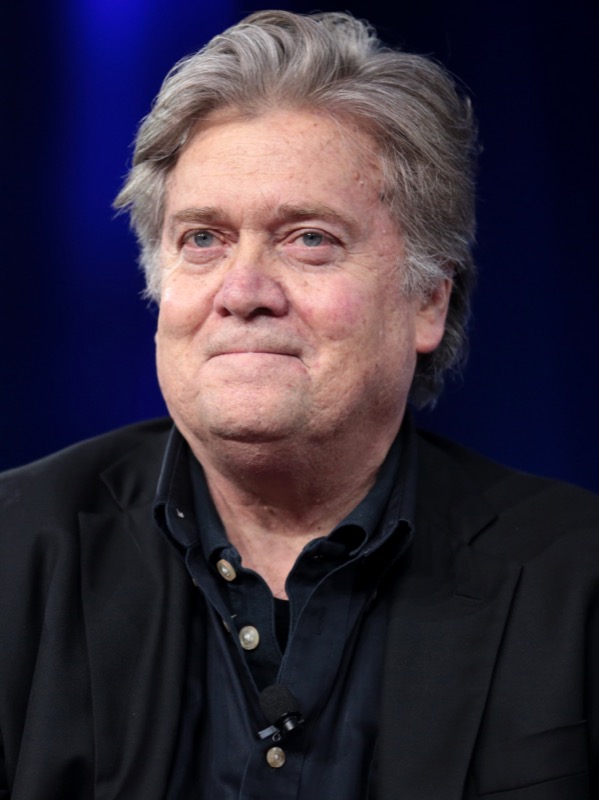
The same month, he hired Steve Bannon as campaign CEO. Bannon ran Breitbart as, in his own words, "the platform for the alt-right"—the rebranded white nationalist movement. After winning, Trump appointed Bannon as Chief Strategist, elevating alt-right ideology to the West Wing.
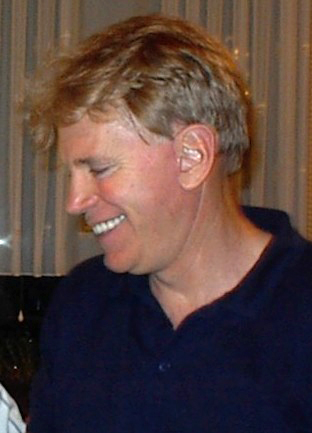
When asked about the KKK's David Duke endorsing him, Trump refused to disavow on CNN, claiming he didn't know enough about Duke or the KKK to comment. He had, of course, denounced Duke by name years earlier.
Charlottesville: The Permission Structure
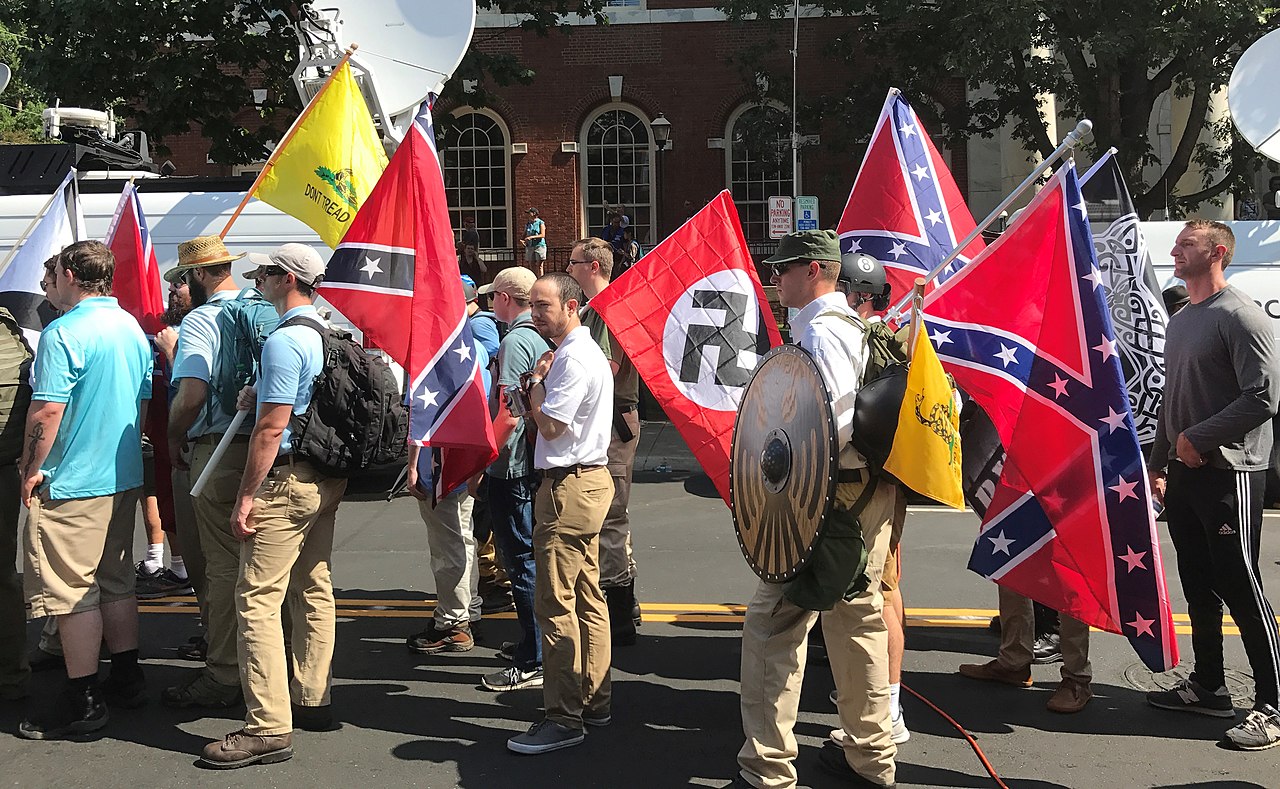
On August 12, 2017, neo-Nazis marched through Charlottesville chanting "Jews will not replace us." A white supremacist murdered counter-protester Heather Heyer in a car attack. Trump's response was to condemn "violence on many sides"—refusing to single out the Nazis who had just committed murder.
Three days later, at Trump Tower, he defended the marchers: "You had some very bad people in that group. But you also had people that were very fine people, on both sides."
David Duke, former KKK Grand Wizard, thanked Trump for his response. The message was received: the violent right had presidential cover.
The Pattern Escalates
Trump didn't just tolerate violence; he praised it. When a Trump supporter mailed pipe bombs to prominent Democrats and CNN in October 2018, Trump continued his rhetoric unchanged.
In April 2020, he tweeted "LIBERATE" commands to incite protests against COVID lockdowns. Armed protesters stormed state capitols.
When protesters targeted Michigan Governor Gretchen Whitmer, Trump amped up his attacks as his crowd chanted "Lock her up." The FBI later arrested men who had plotted to kidnap and murder her.
When a caravan of Trump supporters surrounded and tried to run a Biden campaign bus off the road, Trump tweeted "I LOVE TEXAS!" with a video of the ambush.
When given the opportunity to condemn QAnon—a conspiracy theory claiming Democrats run a satanic child-trafficking ring—Trump refused to disavow and praised his followers: "I've heard these are people that love our country."
"Stand Back and Stand By"
On September 29, 2020, during the first presidential debate, moderator Chris Wallace asked Trump to condemn white supremacists. It should have been the easiest question of the night.
The Proud Boys immediately adopted the phrase as a slogan. They understood it as an order—not a condemnation, but instructions to prepare for action.
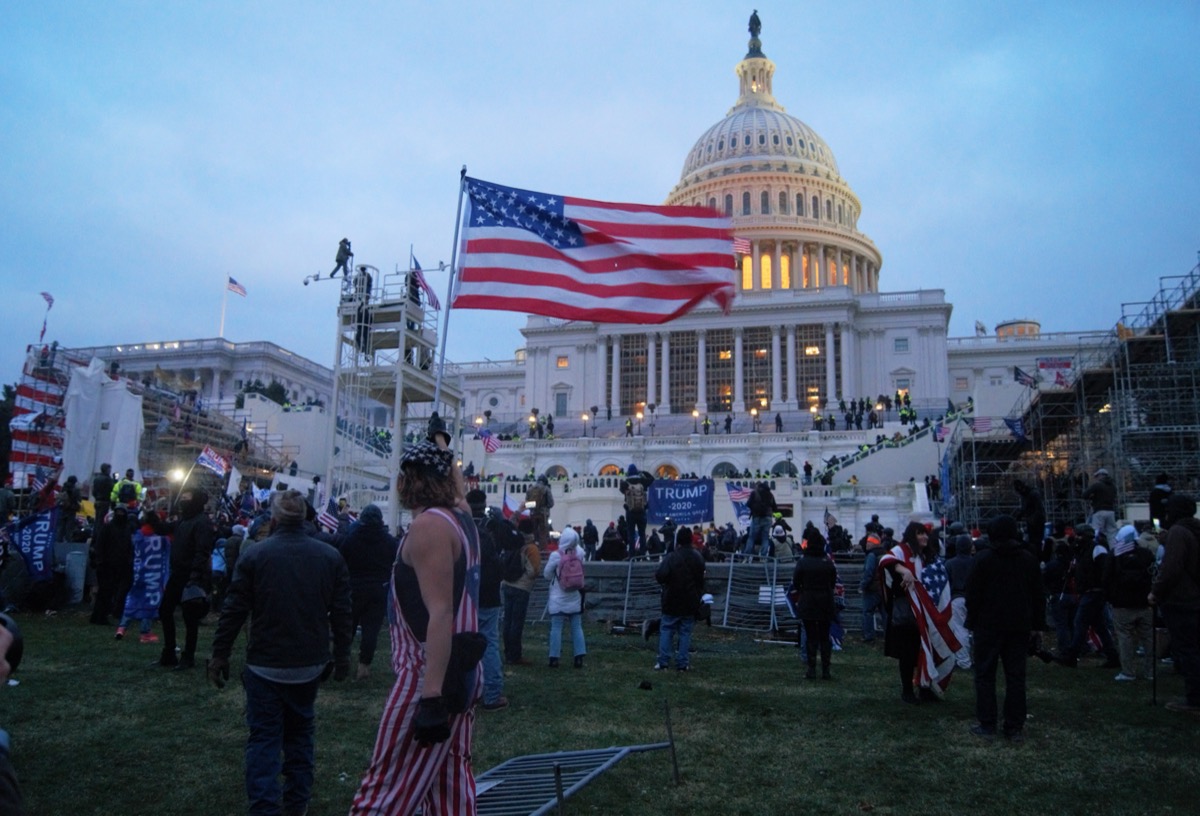
They were right. When Trump summoned supporters to DC on January 6 with "Be there, will be wild!"—they came. The Proud Boys and Oath Keepers were later convicted of seditious conspiracy for their role in the attack, with prosecutors proving they mobilized specifically in response to Trump's commands.
The Pardon Loop
The final step in the fascist paramilitary relationship is reward. Those who commit violence for the leader must be protected by the leader—or the next generation of followers won't take risks.
Trump had called the January 6 rioters "hostages" and "patriots" on the attack's anniversary. He promised to pardon them.
On his first day back in office, Trump granted clemency to approximately 1,500 January 6 defendants—including those convicted of assaulting police officers, including Proud Boys leader Enrique Tarrio with his 22-year seditious conspiracy sentence.
The loop is complete: Signal → Mobilization → Violence → Pardon. Those who commit violence for Trump will be protected by Trump. This is operational command, not rhetorical affinity.
The Rejection of Democracy
The final element of fascism is the explicit rejection of democratic governance. Eco noted fascism's contempt for parliamentary democracy. Trump has moved beyond contempt to open declaration.
December 3, 2022: "A Massive Fraud of this type and magnitude allows for the termination of all rules, regulations, and articles, even those found in the Constitution."
A year later, when Fox News gave Trump an easy opportunity to promise he wouldn't be a dictator, he instead embraced the term. "He says 'You're not going to be a dictator, are you?' I said: 'No, no, no, other than day one.'"
When the New York Times asked what limits existed on his power in January 2026, Trump was explicit:
When asked about international law: "I don't need international law."
This is the endpoint of fascism's logic: the leader's will is the only law. Courts, constitutions, treaties—all are obstacles to be overcome. The leader's morality is sufficient because the leader embodies the nation.
What This Essay Is Not Claiming
A serious analysis requires engaging the strongest objections, not the weakest.
This essay does not claim identity with 1930s Germany or Italy. The United States in 2025 is not Weimar Germany. There are still elections, courts, a free press, and institutional resistance. Trump lost the 2020 election and left office (after attempting to overturn the result). These differences matter.
This essay does not claim that "authoritarian populism" and "fascism" are the same thing. Scholars distinguish between authoritarian leaders who work within democratic systems and fascists who seek to destroy them. The distinction is real.
The claim here is more limited but still serious: Trump's movement exhibits functional overlap with historical fascism in specific, observable mechanisms—particularly the cultivation of paramilitary violence and the leader's protection of those who commit it. The pattern is: dehumanizing rhetoric → mobilization of armed supporters → violence → presidential protection for perpetrators.
Whether this constitutes "fascism" in the full historical sense may be debated. What cannot be debated is that his own generals—men who served him at the highest levels—concluded that it does. And what cannot be debated is the documented pattern of conduct that led them to that conclusion.
Why It Matters
The evidence traces a structural pattern across a decade:
The mythologized in-group: "Real America" under siege, constructed from the 2015 campaign launch through "I alone can fix it" to "poisoning the blood."
The dehumanized out-groups: Immigrants as animals and blood poisoners. Muslims targeted for bans. Media as enemies of the people. Political opponents as vermin.
The paramilitary violence: From "Second Amendment people" through refusal to disavow the KKK through Charlottesville's "fine people" through "stand back and stand by" to mass pardons.
The rejection of democracy: From "I alone can fix it" through "termination of the Constitution" to "my own morality is the only thing that can stop me."
The pattern repeats: delegitimization, dehumanization, mobilization, impunity. This is the architecture that Eco identified in 1995, that Milley and Kelly recognized from the inside.
Does calling it fascism matter? The label carries implications that euphemisms do not. It tells us that the violence isn't incidental but instrumental. It tells us that the people who committed violence for Trump—who were convicted, imprisoned, and are now pardoned and free—were functioning as the movement required them to function.
They were his soldiers. They fought for him. He rewarded them.
That is the mechanism. What we call it matters less than whether we recognize it.