The Top 10 Most Insane and Obvious Lies
Ten lies so brazen, so easily disproven, so obviously false that believing them requires active participation
Donald Trump has told thousands of lies. Fact-checkers have documented over 30,000 false or misleading statements during his first term alone. But not all lies are created equal. Some require parsing, context, or expert analysis to debunk. Others are so obviously, immediately, and spectacularly false that they serve a different purpose entirely: they test whether you will believe your own eyes or submit to the leader's version of reality.
This list catalogs ten of the most insane and obvious lies from the Griftbook archive—not the most consequential (though many are) or the most harmful (though many are), but the most blatant. Each one was caught on tape, contradicted by photographic evidence, debunked in real-time, or later admitted to be false. Each one required its audience to actively choose fiction over fact.
They are presented here not as an argument—the argument is self-evident—but as a record. Because in the anti-reality field, the lies must be documented before they can be memory-holed.
The day after publicly musing about injecting disinfectant to treat COVID-19—"I see the disinfectant, where it knocks it out in a minute. One minute. And is there a way we can do something like that, by injection inside or almost a cleaning?"—Trump claimed he was "being sarcastic."1
The statement was made at an official White House briefing, to his own administration officials, on live television. He turned to Dr. Deborah Birx and asked, "Deborah, have you ever heard of that?" This was not sarcasm directed at reporters. It was a genuine, confused suggestion that was immediately recognized as dangerous. Poison control centers reported a spike in calls. Lysol issued a statement warning people not to ingest their products.
After video showed Trump flailing his arms while mocking New York Times reporter Serge Kovaleski—who has arthrogryposis, a condition affecting his joints—Trump denied mocking his disability. "I never mocked anybody. I would never mock a person that has difficulty."2
The video exists. Trump is clearly flailing his arms in a manner that mimics Kovaleski's condition, while speaking in a mocking voice. He was attacking Kovaleski for not backing up Trump's lie that "thousands and thousands" of Muslims celebrated 9/11 in New Jersey. The mockery was the point—discrediting a reporter who had the temerity to fact-check him.
When Trump filed his FEC disclosure to run for president, he claimed a net worth of over $10 billion. He had been making versions of this claim for decades, suing journalists who reported lower figures.3
Forbes consistently valued him at $3-4 billion—a third of his claim. In 2023, a New York judge ruled that Trump had committed fraud "for decades" by inflating his asset values. The Trump Organization was found to have valued Mar-a-Lago at over $700 million when it was worth perhaps $75 million. Trump himself admitted in a deposition that his net worth varied based on "feelings." In 2024, he was ordered to pay $354 million in damages for the fraud.
After Michael Wolff's Fire and Fury raised questions about his mental fitness, Trump launched a tweetstorm insisting he was "like, really smart" and "a very stable genius."4
Setting aside the question of "genius," even the factual claim was false: this was not his "first try." Trump explored a presidential run in 2000 with the Reform Party, appearing on talk shows, giving policy speeches, and testing the waters before withdrawing. He also publicly flirted with runs in 1988, 2004, and 2012. The claim that he swept into the presidency with no prior attempts is a rewrite of documented history.
At a rally in Alabama, Trump claimed he personally watched "thousands and thousands" of Muslims in New Jersey cheering as the World Trade Center came down on September 11, 2001.5
No video evidence of such celebrations has ever been found, despite 9/11 being one of the most documented events in history. Police, local officials, and extensive media investigations found nothing matching Trump's description. Fact-checkers rated the claim "Pants on Fire." When pressed, Trump cited a single Washington Post article mentioning "tailgate-style" celebrations by "some people"—which the reporter who wrote it said did not support Trump's claim. Trump then mocked the reporter for contradicting him.
After the White House released a memo of Trump's July 25 call with Ukrainian President Zelensky—in which Trump said "I would like you to do us a favor though" after Zelensky mentioned military aid—Trump insisted it was "a perfect call."6
The transcript—released by Trump's own White House—showed him pressuring a foreign leader to investigate a political rival while withholding congressionally approved military aid. Even Trump's own appointees, including Ambassador Gordon Sondland, testified there was a quid pro quo. Trump was impeached for this call. The evidence was his own document.
Three weeks after winning the Electoral College but losing the popular vote by 2.9 million, Trump claimed he actually won the popular vote "if you deduct the millions of people who voted illegally."7
No evidence of mass illegal voting has ever been found. Trump created a "voter fraud commission" to prove his claim; it disbanded without finding fraud. The claim originated from a conspiracy theorist and was amplified by InfoWars. Every court that examined 2020 election fraud claims found them baseless. This tweet was the origin of the "Big Lie"—the claim that any Trump loss is by definition fraudulent.
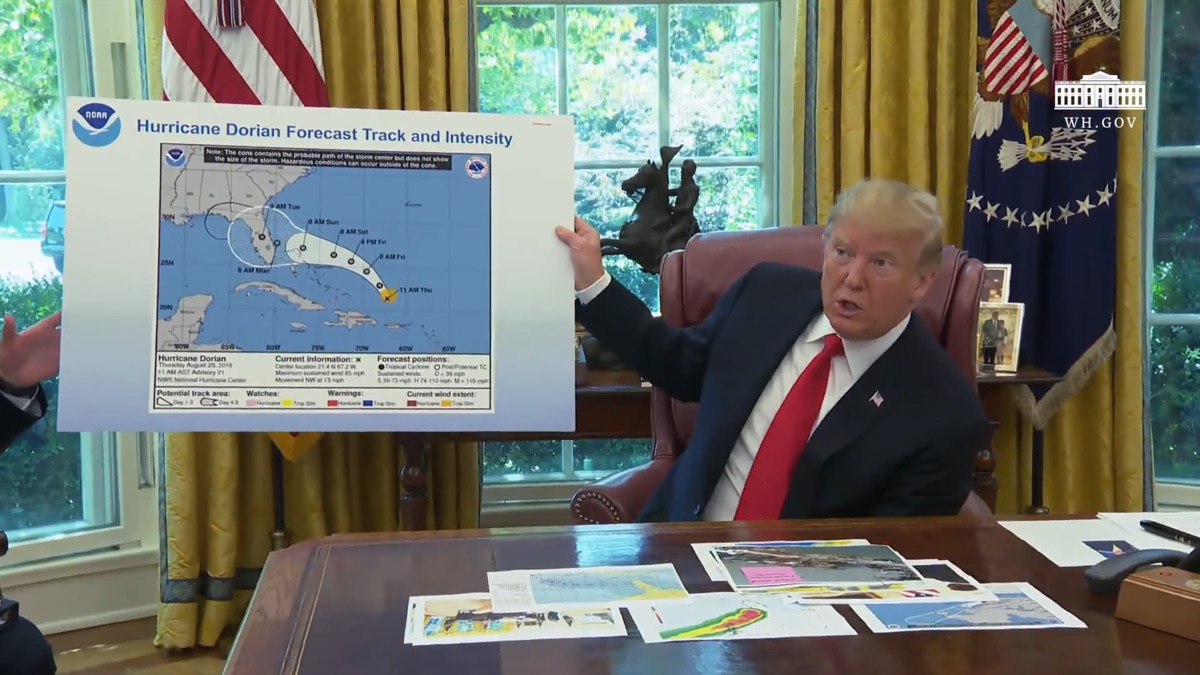
After falsely tweeting that Alabama "will most likely be hit" by Hurricane Dorian, Trump displayed an official NOAA weather map that had been crudely altered with a black Sharpie to extend the hurricane's path into Alabama.8
The National Weather Service in Birmingham immediately contradicted the claim, tweeting: "Alabama will NOT see any impacts from Dorian." The Sharpie addition was visible as a crude hand-drawn bubble on an official forecast map. Rather than admit a trivial error, Trump pressured NOAA to issue a statement backing him up. The Commerce Department's Inspector General later found this was "the result of strong pressure from the White House." Trump corrupted a scientific agency rather than say "I misspoke."
On his first full day as president, Press Secretary Sean Spicer angrily read a statement claiming Trump's inauguration had "the largest audience to ever witness an inauguration, period, both in person and around the globe."9
Side-by-side photographs from the National Mall showed visibly smaller crowds than Obama's 2009 inauguration. Metro ridership data confirmed fewer people traveled to Trump's inauguration. Television ratings were lower. When confronted with these facts, Kellyanne Conway famously defended the claim by saying Spicer had offered "alternative facts"—a phrase that became synonymous with the administration's relationship with reality.
Hours after ICE agent Jonathan Ross shot and killed Renee Nicole Good in Minneapolis, Trump claimed on Truth Social that Good had "violently, willfully, and viciously ran over the ICE Officer." He added: "It is hard to believe he is alive, but is now recovering in the hospital."10
The video, released two days later, showed Good's car driving away from the agent, with her wheels pointed to the right. Ross was never in the vehicle's path. He was seen walking around the scene afterward, unhurt. There was no hospitalization. There was no injury. Ross had to pivot to avoid the car, but he was never struck. The claim that Good "ran over" anyone—that she committed an "act of domestic terrorism," as Secretary Noem called it—was fabricated from whole cloth while her body was still at the scene.
The Pattern
What connects these lies is not their subject matter but their audacity. Each one was immediately disprovable. Each one required witnesses, recordings, documents, or photographs to be ignored. Each one demanded that believers choose loyalty over their own senses.
This is the function of the obvious lie: not to persuade, but to dominate. When Sean Spicer claimed the inauguration crowd was the largest in history, the point was not that anyone would believe him. The point was that he would say it anyway. The point was that the White House press corps would report it anyway. The point was that Republican officials would repeat it anyway.
When Trump claimed Renee Nicole Good "ran over" an officer, the video already existed. The witnesses were already talking. The evidence was already circulating. He lied anyway—and his Cabinet secretaries repeated the lie anyway, and his media allies amplified the lie anyway, and his supporters believed the lie anyway.
The lie is not meant to deceive. It is meant to require participation. Every official who repeats it, every anchor who "both-sides" it, every supporter who defends it, has passed through the anti-reality field. They have demonstrated that they will believe what they are told to believe, regardless of what they see.
That is the purpose of the obvious lie. That is why it must be documented. Not to convince anyone—the evidence is self-evident—but to ensure there is a record when the memory-holing begins.
Here is the record. The lies are on tape. The evidence exists. The truth is not in dispute.
Whether it matters is up to us.
Notes & Sources
- Trump's "sarcasm" claim after disinfectant suggestion. View in Griftbook
- Trump mocks disabled reporter Serge Kovaleski while defending his 9/11 lie. View in Griftbook
- Trump's $10 billion net worth claim in FEC filing. View in Griftbook
- "Very stable genius" tweet after Fire and Fury. View in Griftbook
- "Thousands and thousands" cheered 9/11 claim. View in Griftbook
- "Perfect call" claim about Ukraine transcript. View in Griftbook
- "Millions voted illegally" claim. View in Griftbook
- Sharpiegate: altering NOAA hurricane map. View in Griftbook
- Sean Spicer's "largest audience ever" claim. View in Griftbook
- Trump's false claim that Renee Good "ran over" ICE officer. View in Griftbook