The Ballroom and the Grocery Bill
One sentence at an Atlanta rally went viral because every clause of it is documented — the ballroom, the borrowed palace, the deception — and because the country hearing it is paying more for groceries while being told a shrinking labor market is a resurgence.
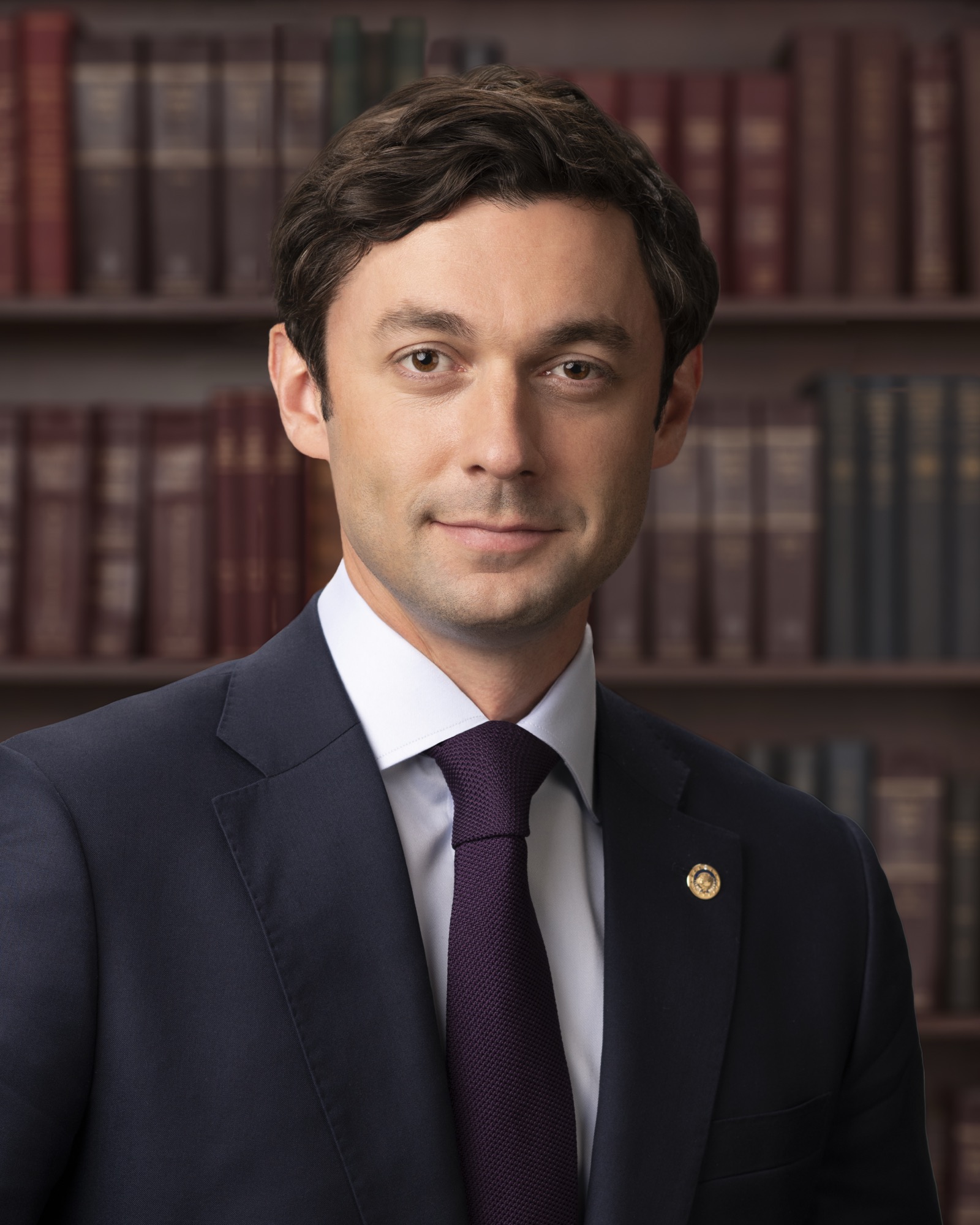
On August 17, 2026, at a rally in Atlanta, a senator from Georgia said one sentence about the President of the United States: he "wants to build his ballroom and travel with Natalie on their apparently defenseless flying palace gifted by the Emir of Qatar."
The sentence went viral. And the White House — the official White House, through its official channels — responded. The communications director of the United States government posted that Jon Ossoff "has to be the biggest cuck loser in politics." The President of the United States, asked about a sitting senator's criticism, answered: "You mean Pee-wee Herman? Pee-Wee Herman look-alike?" A White House spokesman added that the senator was a "cringeworthy, feminine theatre kid cosplaying as Barack Obama."
Notice what is missing. The ballroom was not denied. The plane was not denied. The gift from the Emir of Qatar was not denied. The word "defenseless" was not denied. The White House had three insults for the messenger and no answer for the sentence — because the sentence is not an insult. It is an inventory.
This archive holds the inventory. What follows is the sentence, walked clause by clause through the documented record — and then the ground beneath the sentence: the jobs numbers, the grocery bills, and the approval ratings that explain why twelve seconds of mockery in Atlanta landed harder than any position paper, and why the answer to it was "cuck loser."
"His Ballroom"
Start with the first clause.
In October 2025, the East Wing of the White House — the wing that had housed the Office of the First Lady, the wing schoolchildren entered on tours — was demolished without review by the National Capital Planning Commission to make way for a ballroom. The project was announced in July 2025 as a 90,000-square-foot "event space" costing $200 million, promised to be privately funded — in the President's own repeated phrase, "not one dime of government money."
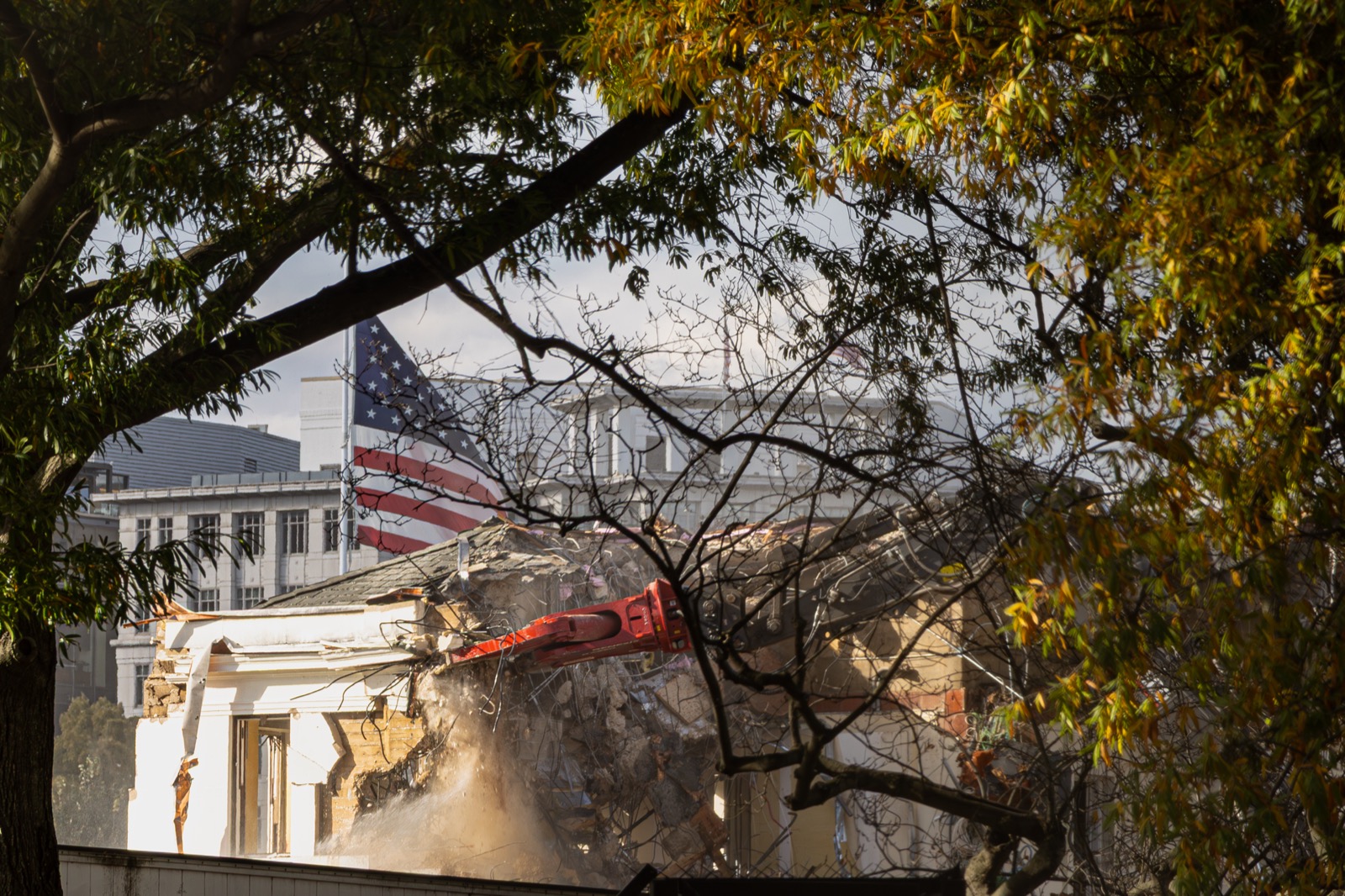
Then the price became $400 million. Then the courts arrived. In March 2026, U.S. District Judge Richard Leon called the project "brazen" from the bench — "I'm struggling to see this as an alteration" — and within two weeks halted construction, ruling that the President is the "steward" of the White House, not its "owner," and cannot demolish and rebuild it without Congress.
The response to the ruling is its own chapter in the record. The President called the judge "Trump Hating"; the judge, in turn, called the administration's reading of his order "incredible, if not disingenuous," and warned that security concerns are not a "blank check." When a shooting occurred at the White House Correspondents' Association dinner in April, the President held a press conference the same day to argue that the shooting gave "new urgency" to the construction of a 1,000-seat ballroom. By May he was explaining that the ballroom required a rooftop "DronePort" — "perhaps, the most sophisticated anywhere in the World" — because Washington "can no longer be defended with only rifles and pistols."
And the private funding? In May 2026, Senate Republicans proposed $1 billion in taxpayer money for "security adjustments and upgrades" at the White House, including the ballroom site. FactCheck.org documented the proposal as the plain contradiction of the "not one dime" promise the President had been repeating since the project's announcement. When his own party balked at the optics, he did not retreat: he demanded the $1 billion anyway, and the demand killed the Republicans' own $70 billion immigration enforcement bill — the party's signature issue, derailed by the party's president, over the security budget for his personal venue.
The through-line continued into the very week of the Atlanta rally. On August 7, a federal appeals court ruled 2–1 that the project requires congressional approval; the President called the ruling "horrendous, politically motivated and unlawful" and announced he would go to the Supreme Court. On August 15 — two days before Ossoff spoke — he posted that the preservationists suing him were "TREASONISTS," and dismissed one of them, a historian on the National Trust's board, as a "woman walking her dog."
That is the first clause of the sentence. "He wants to build his ballroom" is not a caricature. It is a précis of ten months of documented conduct: a demolished wing, a doubled price, a broken funding promise, a derailed party agenda, an attacked judiciary, and a president who described the house he was renovating — the White House — as having been "a shit house" before he got to it.
"Their Apparently Defenseless Flying Palace, Gifted by the Emir of Qatar"
The second clause has more moving parts, and every one of them is documented.
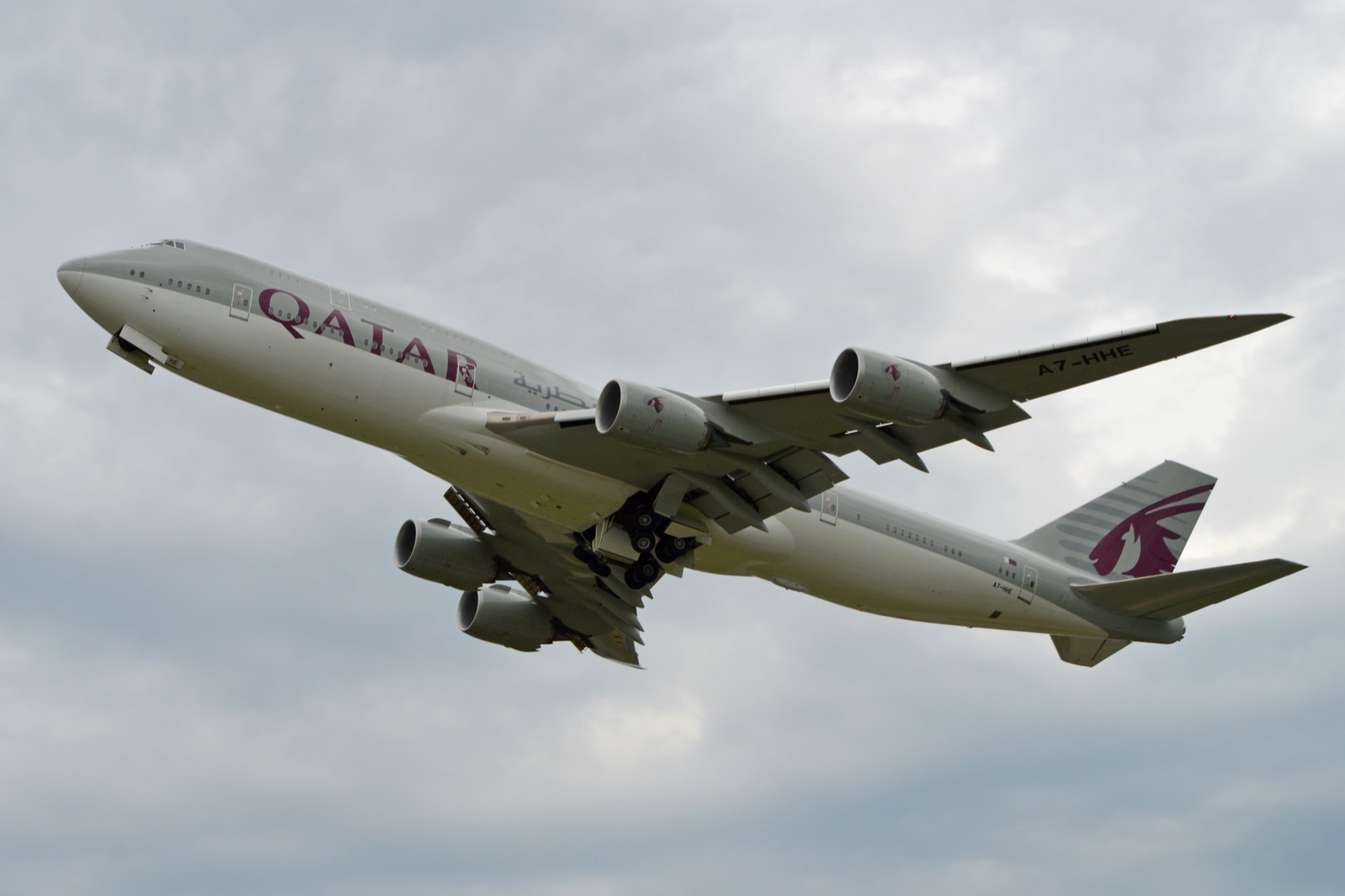
The plane is real. In May 2025, the Department of Defense formally accepted a Boeing 747-8 "flying palace" from the royal family of Qatar, after the Attorney General's Justice Department produced a memo blessing the arrangement. The President's defense was characteristically direct: "Why should our military, and therefore our taxpayers, be forced to pay hundreds of millions of Dollars when they can get it for FREE from a country that wants to reward us for a job well done." Constitutional scholars called it "precisely the kind of gift the clause was written to prohibit" — the clause being the Foreign Emoluments Clause — and one called the approval memo "transparent baloney." The structure that alarmed them is worth stating plainly: the jet serves as Air Force One while Trump is president, then transfers to the Trump Presidential Library Foundation when he leaves office. A foreign monarchy's quarter-billion-dollar aircraft, routed through the Pentagon, landing in the personal orbit of the man it was given to. House Judiciary Democrats opened an investigation; the House took up a resolution demanding the plans be submitted to Congress under the Emoluments Clause.
"FREE" then acquired a price. In July 2025, the New York Times reported that the Air Force had quietly diverted $934 million from the Sentinel intercontinental ballistic missile modernization program toward the classified project of converting the jet. The Air Force Secretary told Congress the conversion was running "on the order of $1 billion" — while the administration continued, into 2026, to reaffirm a public estimate of "less than $400 million." Both numbers are in the record. They cannot both be true.
The retrofitted jet flew as Air Force One for the first time on July 1, 2026, repainted from the traditional light blue to a navy-and-gold livery matching the President's preference, with lie-flat seats, wood paneling, and presidential seals on the seat belts. His comment on the aesthetics: "You can do two things: You can low-key it, or you can show it."
Now the word "defenseless" — the word the White House conspicuously declined to dispute. When the New York Times reported that the new jet lacked antimissile defenses, the administration's response was not to refute the reporting. It was to have the FBI deliver grand-jury subpoenas to the four reporters, some at their homes. Days later, the reporting was validated by events: departing the NATO summit in Ankara amid a credible Iranian threat, the President abandoned the Qatari jet for the older Air Force One — because, per the Secret Service's recommendation, the older plane has the advanced defensive systems.
And then the part the public was not supposed to learn. In August, the Washington Post revealed that the Ankara departure had been more than a plane swap: the President was moved through a catering truck onto a smaller military aircraft while the press corps — and his own Cabinet — rode a decoy, unaware they were not with the president. The security operation itself may have been justified. The lie was a choice. Rather than declining to comment, the White House supplied a false explanation — that the Qatari jet had been sent ahead "to show troops." The handful of aides the President selected for the covert flight included his deputy chief of staff, his director of Oval Office operations, and his executive assistant, Natalie Harp — the "Natalie" of the Atlanta sentence. The Secretary of State stayed on the decoy, in the dark. A senator called for a congressional investigation into both the security and the deception.
One note on Harp, because this archive documents the President's conduct and no one else's: she is a staffer who was put on a plane. The documented offenses in this thread belong to the administration — the acceptance of the gift, the hidden costs, the subpoenas, the false cover story. The sentence's sting was never about the aide. It was about the palace, who paid for it, and what her presence on the secret flight revealed about whom the White House informs and whom it deceives.
So: "their apparently defenseless flying palace gifted by the Emir of Qatar." A foreign gift accepted over emoluments objections. A billion dollars, some of it drawn from the nuclear deterrent, spent on a plane announced as free. A jet whose missing defenses were reported by journalists who were then subpoenaed, confirmed by a president who then fled it, and papered over by a cover story that was then exposed. Every word of the clause holds.
The Arithmetic
A sentence like Atlanta's does not go viral in a country that feels prosperous. Mockery of a gilded palace lands when the audience is standing in a grocery aisle. The archive documents both halves: what Americans are living through, and what they are being told about it.
Take the week before the rally. On August 7, 2026, the Bureau of Labor Statistics reported that the economy lost 23,000 jobs in July. Economists had forecast a gain of eighty to ninety-five thousand. The same report revised May and June down by a combined 103,000 jobs — May's reported 129,000 became 63,000; June's 57,000 became 20,000. The labor market had not merely slowed. For the month, it shrank.
The White House response, in full, from its spokesperson: "The Trump industrial resurgence is on schedule. Manufacturing and factory construction jobs grew again in July even as government payrolls continued to significantly shrink. Unemployment claims are at record lows." The statement cited July's 22,000 construction jobs and 5,000 manufacturing jobs, and omitted the net loss and the revisions entirely. Days earlier, a White House press release had claimed manufacturing "surged in July at the strongest rate in more than four years"; federal payroll data show the economy has lost a net 75,000 manufacturing jobs since the inauguration. The same jobs report found employment among U.S.-born workers down 720,000 over twelve months — the precise constituency the administration had spent months falsely claiming was capturing "all net job creation."
Three days before the rally, the President posted a chart. It showed him with the lowest inflation of any recent president — a result achieved by comparing his 18 months against his predecessors' full 48, freezing his rate and assuming zero inflation for the remaining 30 months of his term. At the 18-month mark, his actual cumulative inflation ranked fourth highest of the last ten presidential terms. He then went on an interview program and claimed to be "lowest of the last 10 presidents on inflation."
Two weeks before the rally, he told a Fox News audience that prices are "all coming down now. The food, the groceries, it's all coming down." The fact-check arrived with a receipt column: overall prices up approximately 4.3 percent since his term began. Groceries up 3.4 percent. Coffee up 35 percent. Ground beef up 23 percent. Steak up 21 percent. Gasoline up 34 percent, fuel oil 24 percent, electricity 8 percent — energy costs driven substantially by the Iran war he started in February. This is the grocery bill half of the split screen: the one voters carry to the register while the ballroom's marble is litigated.
Two days after the rally, with mortgage rates climbing, he hosted cryptocurrency executives in the Roosevelt Room and explained that the problem was the Federal Reserve's "political board" — "they vote to raise interest rates," he said, wondering aloud whether they "like the politics of it." The Federal Open Market Committee has not voted to raise rates since July 2023. It cut rates three times in late 2025. The claim was not spin on a real grievance; the thing described simply never happened.
None of this began in August. The pattern is a settled house style, and the archive holds its full run. In December 2025, in a single national address, he claimed egg prices were down 82 percent (the actual figure was 43), that Thanksgiving turkeys were down 33 percent, and that "inflation has stopped" — while CPI ran at 3 percent and analyses attributed roughly half a point of it to his tariffs, 82 percent of whose costs are paid by American companies and consumers. That same month he told families struggling with prices that children need "1 or 2" pencils instead of 37, and "two or three" dolls — advice delivered weeks before Christmas, as 60 percent of Americans told pollsters he makes inflation "sound better than it really is." In January he posted unreleased federal jobs data on Truth Social twelve hours before the official release, violating the embargo that exists to prevent market manipulation. In April, FactCheck.org's quarterly audit documented the divergence wholesale: job growth slowing, unemployment rising, inflation worsening, gas prices climbing after the strikes on Iran — against a president claiming more Americans were working than at "any time" in history. In May he declared consumer confidence "way up" while sentiment measures sat at or near all-time lows, roughly 30 to 40 percent below pre-pandemic levels. In July, inflation was "way down" — at 3.5 percent, higher than the day he took office.
Line the two columns against each other. In one: a shrinking labor market, a 4.3 percent price ratchet, a war premium on energy. In the other: "resurgence," "all coming down," "way up," "way down," "stopped." The distance between the columns is the space where the Atlanta sentence detonated.
The Numbers He Cannot Post Away
There is one number the machine works hardest on, because it measures the machine itself.
In December 2025, with five major polls showing him at 36 to 41 percent approval, the President posted that his "real" approval rating was +64 — a figure roughly 76 points from the measured reality, in which his net approval stood at minus 12 overall and minus 43 among independents. In February, at second-term lows across Gallup, YouGov, Morning Consult, and Quinnipiac, he announced "The highest poll numbers I have ever received." In May, he converted an NBC poll showing 100 percent approval among self-identified MAGA supporters into a claim of 100 percent approval "within the Republican Party" — attributing it, for good measure, to the wrong network — while his overall disapproval reached a second-term high of 59 to 64 percent. By mid-August 2026, the week of the Atlanta rally, wire-service and academic surveys were putting his approval at 33 percent, the lowest of his second term. That last number is not yet an event in this archive, because the archive documents his conduct, and his conduct regarding it — so far — has been silence.
Where the numbers could not be denied, the instinct has been to punish the instrument. He expanded his $15 billion defamation lawsuit against the New York Times to include an unfavorable poll — a poll showing him at 40 percent — calling the survey "fake" and "fraudulent" and suggesting that unfavorable polling should be criminalized. Sit with that for a moment: a President of the United States proposed making it a crime to measure his unpopularity.
The same reflex governs the administration's whole media posture. When a Democratic congressman criticized him on Fox News, the President declared he "should not be allowed on FoxNews" without an anchor to dispute him — the pundit-in-chief assigning debate conditions to a private network. When the White House formally pressed the broadcast networks to carry his primetime election address in July, ABC, NBC, and CNN declined — a small event with a large implication, because it means the audience is no longer compulsory.
This is the context in which the response to Ossoff should be read. The "cuck loser" post was not an aberration of tone; it is the documented house style of an operation that calls plaintiffs traitors, judges haters, congressmen sleazebags, and pollsters criminals-in-waiting. What changed in August was not the machine. What changed is that the machine is now punching at a sentence that is true, in front of an audience that can check.
The New Dynamic
For a decade, the pattern this archive documents ran mostly one direction: the President coins the nickname, the target explains himself, the explanation loses to the nickname. The Atlanta exchange inverted it. A senator compressed ten months of documented record into one sentence — palace, patron, defenselessness, entourage — and the White House found itself in the explaining seat, except it did not explain. It called him a theatre kid.
The inversion has a mechanism, and the mechanism is the rest of this essay. Ridicule sticks when it is load-bearing — when every clause can take the weight of a fact-check, and this sentence can, clause by clause. And ridicule of a palace lands when the audience is paying 35 percent more for coffee while being told the groceries are coming down, watching 23,000 jobs disappear while being told the resurgence is on schedule, and hearing a man whose disapproval sits at a second-term high describe his poll numbers as the highest ever recorded. The anti-reality field still broadcasts. It no longer covers.
What the White House communicated in August, precisely, was this: presented with a true sentence, it had no false sentence good enough to answer with. So it reached for "cuck loser" — the argument of last resort, deployed on the official channel of the United States government against a sitting senator, in a state whose Senate race may decide control of the chamber. The vulgarity is documented. So is everything it was trying to drown out.
The ballroom is still in litigation, headed for the Supreme Court under a president who calls the plaintiffs traitors. The palace still flies, a billion quiet dollars later, defended by subpoenas where it is not defended by countermeasures. The grocery bill is still 4.3 percent heavier. The labor market is still shrinking. The approval rating is still 33. None of these facts respond to nicknames. That, in the end, is the new dynamic: the record has gotten too heavy for the insults — and the record is one click down from every sentence in this essay.